
Northumberland is a county with a long memory.
Its castles have endured sieges, its borderlands have witnessed centuries of violence, and its monasteries have survived invasions, abandonment and the occasional Viking raid.
It should perhaps come as no surprise, then, that quite a few of its former inhabitants are said to have never entirely left.
There are ghostly ladies wandering castle corridors, knights condemned to search for lost loves, monks who apparently still have duties to attend to, and at least one medieval vampire.
I've been looking into some of Northumberland's better-known ghost stories, along with a few lesser-known tales that deserve an airing.
Whether you believe in ghosts is entirely your business. Personally, I find the history behind these stories considerably more interesting than the prospect of encountering an apparition.
Nevertheless, October seems an appropriate month to explore them.
And if you happen to see something unusual, do let us know.
Preferably after you've ruled out the obvious explanations.
1. Chillingham Castle — The White Pantry Ghost
If Northumberland has a spiritual headquarters for ghostly activity, Chillingham Castle would probably claim the title.
Situated near Wooler, this medieval fortress has developed a formidable reputation for hauntings, with stories involving mysterious voices, unexplained footsteps and figures appearing where no living person ought to be.
Among the best-known is the White Pantry Ghost.
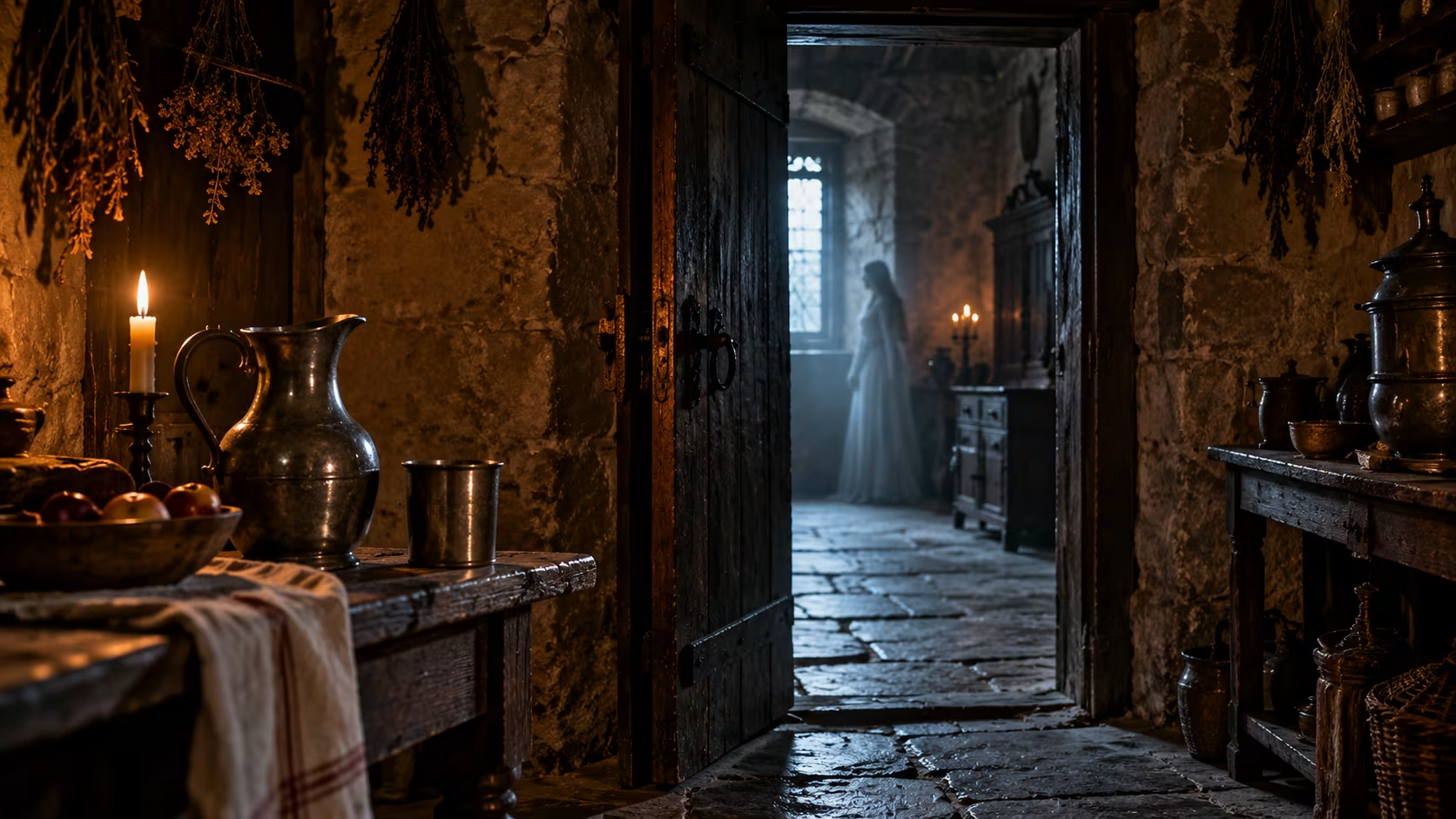
According to the castle's accounts, a pale female figure has been seen in the pantry, sometimes accompanied by requests for water. One particularly curious detail is that the room was reportedly locked when the apparition appeared.
Chillingham also has tales associated with the Blue Boy, a ghost traditionally linked to a bedroom and strange cries heard during the night.
The castle's history is certainly substantial. Its position near the Scottish border placed it within a region repeatedly affected by conflict, and the building has witnessed centuries of occupation and change.
Today, Chillingham makes rather more of its supernatural reputation than most historic properties, offering organised ghost tours and overnight investigations.
I suspect the latter attract two distinct groups: those hoping to encounter a ghost, and those quietly hoping they don't.
Worth knowing: Chillingham Castle is near Wooler and offers seasonal visitor access and bookable ghost experiences. Check the official website for current dates and availability.
2. Bamburgh Castle — The Pink Lady
Bamburgh Castle needs little assistance in creating an atmosphere.
Perched high above the Northumberland coastline, its enormous stone walls dominate the surrounding beaches and village. On a misty October morning, it looks precisely like the sort of place where an ancient legend might survive.
And indeed, it has one.
The Pink Lady is said to be the ghost of a young woman whose romantic hopes ended in tragedy.
Versions of the story differ, but the central tale involves a princess whose father disapproved of her chosen lover. Heartbroken and believing herself abandoned, she threw herself from the castle.
Her spirit is said to return wearing pink, sometimes described as wandering towards the sea.

Some tellings suggest she appears only once every seven years.
Which, if accurate, makes the chances of an encounter rather slim.
The story belongs firmly to folklore, but Bamburgh's documented history is remarkable enough without embellishment. The site has been an important stronghold since the early medieval period and was associated with the kings of Northumbria.
Worth knowing: Bamburgh Castle is open to visitors on selected dates throughout the year. The surrounding beach offers magnificent views of the fortress, particularly when the weather turns dramatic.
3. Dunstanburgh Castle — Sir Guy the Seeker
Of all Northumberland's ruined castles, Dunstanburgh may be the most atmospheric.
Standing alone on a rugged stretch of coastline between Craster and Embleton, its broken towers seem almost deliberately designed to encourage ghost stories.
The most famous concerns Sir Guy the Seeker.
According to legend, Sir Guy encountered a mysterious figure who led him into an enchanted chamber beneath the castle.
There he found a beautiful maiden lying motionless, with a choice of objects that might determine whether she could be freed.
Sir Guy chose incorrectly.
The opportunity vanished, the maiden remained imprisoned, and Sir Guy was condemned to continue searching for her.
Like many traditional tales, the details vary depending on who is telling it.
What remains consistent is the idea of a restless knight wandering the castle, still searching for the woman he failed to rescue.
The National Trust has featured the legend in a self-guided ghost walk around Dunstanburgh.
The ruins themselves date largely from the 14th century, when Thomas, Earl of Lancaster, began building the fortress.
There is no historical evidence for Sir Guy's supernatural adventure, although I imagine that comes as little surprise.
Worth knowing: Dunstanburgh is reached on foot, most commonly from Craster. The coastal approach is one of Northumberland's finest walks, although the ground can be exposed, muddy and slippery in poor weather.
4. Alnwick Castle — The Alnwick Vampire
Long before Bram Stoker wrote Dracula, Northumberland apparently had a vampire problem.
The story appears in the writings of William of Newburgh, a 12th-century chronicler who recorded accounts of the dead supposedly returning to trouble the living.
One such tale concerns a man associated with Alnwick whose behaviour in life was far from admirable.
After his death, he was said to rise from his grave and wander through the town at night.
His appearances were blamed for sickness and fear among the inhabitants.

Eventually, according to the account, his grave was opened and his body dealt with in a manner intended to prevent further disturbances.
The story is particularly interesting because it illustrates how medieval communities sometimes attempted to explain disease, sudden death and misfortune.
Today, we have rather better explanations for epidemics than wandering corpses.
Although I suspect the medieval version was considerably more exciting around the fireside.
Alnwick Castle itself has nearly a thousand years of history, making it a fitting backdrop for such an extraordinary tale.
Worth knowing: Alnwick Castle is a major visitor attraction with seasonal opening. The vampire story is associated with medieval Alnwick, rather than a confirmed haunting inside the castle.
5. Woodhorn — The Phantom Cyclist
Not every Northumberland ghost requires a castle.
Some prefer a bicycle.
Near St Mary's Church at Woodhorn, local folklore tells of a mysterious cyclist appearing around dusk.
The figure is sometimes described as wearing old-fashioned miners' clothing, with a pale or grey face and an unsettling appearance.
Like many regional ghost stories, the tale is difficult to trace to a single reliable original account.
Nevertheless, it has found its way into collections of Northumberland's reported hauntings.
Woodhorn's mining heritage gives the story a particularly local character.
For generations, coal mining shaped the lives of families in this part of the county. The landscape still carries reminders of that industrial past.
Whether the phantom cyclist represents an actual reported encounter, an embellished local memory or simply a good story is impossible to establish.
I would suggest that anyone encountering a cyclist after dark first checks whether he has working lights.
Worth knowing: Woodhorn lies near Ashington. The wider area includes Woodhorn Museum, which explores Northumberland's coal-mining history. The ghost story should not be taken as evidence of any particular incident at the church.
6. Kielder Castle — Spirits Among the Trees
Northumberland's forests possess a different sort of atmosphere from its coast.
At Kielder, the trees seem to absorb sound, and even familiar paths can feel strangely remote when the light begins to fade.
Kielder Castle, originally built as a hunting lodge for the Dukes of Northumberland, has acquired several supernatural stories over the years.
Reported apparitions include a Victorian lady, a mysterious horseman and a servant girl whose unhappy romantic history supposedly left her unable to rest.
These are traditional haunting accounts rather than independently established events.
Yet the setting undoubtedly helps.
Kielder Forest is vast, and away from the busier visitor areas it is possible to experience a degree of quiet that is increasingly uncommon.
One can easily understand how an unexpected sound, movement between trees or distant animal call might acquire supernatural significance.
Particularly after dark.
Worth knowing: Kielder is best explored through its established visitor areas, walking routes and forest trails. Access to Kielder Castle itself should be checked before travelling; the building is not necessarily open to visitors.
7. Holy Island — The Ghostly Monks of Lindisfarne
Few places in Northumberland carry as much spiritual and historical significance as Holy Island.
Lindisfarne became one of the most important centres of early Christianity in Britain, associated with saints including Aidan and Cuthbert.
The island's monastery was famously attacked by Vikings in AD 793, an event that sent shockwaves through the Christian world.
With such a history, it was perhaps inevitable that stories of ghostly monks would emerge.
Visitors have occasionally reported figures resembling monks around the island's religious ruins, while some traditions associate unexplained appearances with St Cuthbert himself.
These accounts belong to the island's folklore rather than its documented history.
Nevertheless, Lindisfarne can be extraordinarily atmospheric.

The ruined priory, narrow village streets and surrounding tidal landscape create a powerful sense of separation from the mainland.
Twice daily, the rising sea covers the causeway, temporarily restoring the island's isolation.
Of all the places in this guide, Holy Island may be the one where the boundary between history and imagination feels thinnest.
Worth knowing: Always check the official Holy Island causeway safe-crossing times before travelling. Never attempt to cross outside the published safe periods. The island's historic sites have their own seasonal opening arrangements.
8. Winter’s Gibbet, Elsdon
Some of Northumberland's darkest stories require no supernatural explanation at all.
Winter's Gibbet, standing in an exposed position near Elsdon, commemorates a particularly brutal chapter in the county's history.
In 1791, Margaret Crozier was murdered during a robbery at her home near Elsdon.
William Winter was subsequently convicted and executed, along with accomplices, for his part in the crime.
Winter's body was displayed in chains as a warning to others, giving the location its enduring name.
The original remains are long gone, but a gibbet structure continues to mark the site.
Unsurprisingly, ghost stories have grown around it.
Local folklore has suggested that Winter's restless spirit still haunts the surrounding moorland.
Whether or not one believes such accounts, there is something undeniably unsettling about the place.

An isolated structure on a bleak hillside, connected to a real murder and an era when public executions were intended to serve as a spectacle.
No invented ghost is required to make that history disturbing.
Worth knowing: Winter's Gibbet is in a remote, exposed location near Elsdon. Visit in daylight, check access conditions and take suitable clothing. There are no visitor facilities at the monument itself. See our Winter’s Gibbet listing for directions and visitor details.
Why Does Northumberland Have So Many Ghost Stories?
Northumberland's reputation for hauntings is hardly surprising when one considers its past.
For centuries, this was contested territory.
Armies crossed its borders, castles changed hands, villages suffered raids, and communities lived with the uncertainty of conflict.
The Border Reivers added their own chapter of violence and lawlessness, while the county's religious houses accumulated stories of saints, miracles and mysterious events.
Many ghost legends appear to reflect those experiences.
A wandering soldier may represent memories of warfare. A grieving woman becomes a story of lost love. A restless monk preserves the atmosphere of an abandoned monastery.
Others seem to have developed simply because an unusual place invites an unusual explanation.
A ruined castle on a lonely headland is considerably more likely to inspire a ghost story than a modern supermarket.
Although I wouldn't rule anything out.
Exploring Haunted Northumberland This October
You don't need to believe in ghosts to enjoy these places.
In fact, the history is often more compelling than the haunting.
Chillingham offers an organised supernatural experience for those who want one. Bamburgh and Dunstanburgh combine their legends with some of the county's most spectacular scenery.
Alnwick provides a fascinating glimpse into medieval beliefs, while Holy Island offers something quieter and more reflective.
And Winter's Gibbet is a reminder that sometimes the most unsettling stories are the ones we know actually happened.
If you're planning an October outing, check opening times, access arrangements and the weather before setting off. Many of these locations are exposed, and some are best visited as part of a daytime walk.
Historic ruins, churchyards and remote monuments should always be treated with respect.
There's no need to trespass, climb unsafe structures or venture into dangerous places in pursuit of an apparition.
A Final Thought
I've spent some time considering why ghost stories survive.
Most of us no longer accept supernatural explanations for everyday events quite as readily as our ancestors did.
Yet the stories remain.
Perhaps that's because they're really about something else.
Love, loss, guilt, fear and the difficulty human beings have in accepting that everything eventually comes to an end.
Or perhaps there really is a lady in pink wandering the battlements at Bamburgh.
I can't offer any evidence for the latter.
But if you're walking beneath the castle on a quiet October evening and happen to glimpse something moving between the ancient stones, I suspect you'll remember the story.
And you may find yourself walking just a little faster.
Peter
An atmospheric Northumberland castle filled with curious collections, unsettling corners and gardens that offer a welcome breath of fresh air.
View in Listed →The dramatic clifftop castle at the heart of the village, with state rooms, centuries of history and a beach right on its doorstep.
View in Listed →Dramatic 14th-century ruins on a headland reached by an easy coastal walk from Craster, one of the most photographed castles on this stretch of coast.
View in Listed →The Percy family’s home for over 700 years and Hogwarts in the first two Harry Potter films, with glorious Italianate State Rooms. Open late March to October.
View in Listed →England's largest man-made lake set within its largest working forest, with cycling and walking trails, watersports, wildlife cruises and some of the darkest skies in the country.
View in Listed →Atmospheric ruins where St Aidan founded his monastery in the seventh century, with a small museum and views back across the water to the Northumberland coast.
View in Listed →The extraordinary tidal road to Holy Island — beautiful, memorable and completely disappearing beneath the North Sea twice each day.
View in Listed →A lonely replica gibbet on the moor above Elsdon, marking where William Winter's body hung in chains after the 1791 murder of Margaret Crozier. Eerie even at noon.
View in Listed →Where Is Everybody?
Tom
An empty causeway, a murder story from a little book hut, a tide that strands us, a black rabbit, singing from the lime kilns, and a missing Meg.
Read the story →Before Northumberland, There Was Northumbria
Peter
We finally handed the Journal to someone who actually knows Northumberland's history. Peter takes us from Hadrian's Wall to the Border Reivers, with a detour via a great many stolen cattle.
Read the story →The Castle We Thought We Knew
Lucy
After years of driving past, we finally slowed down to properly explore Bamburgh Castle — a beach walk with Meg, breakfast at The Lord Crewe, and centuries of history inside the walls.
Read the story →Where the Castle Waits
From Howick Sands to Dunstanburgh Castle, via smoked kippers, sea cliffs and a castle that never looks the same twice.
Read the story →
Join the conversation
Got somewhere we should try? Tell Tom & Lucy below.