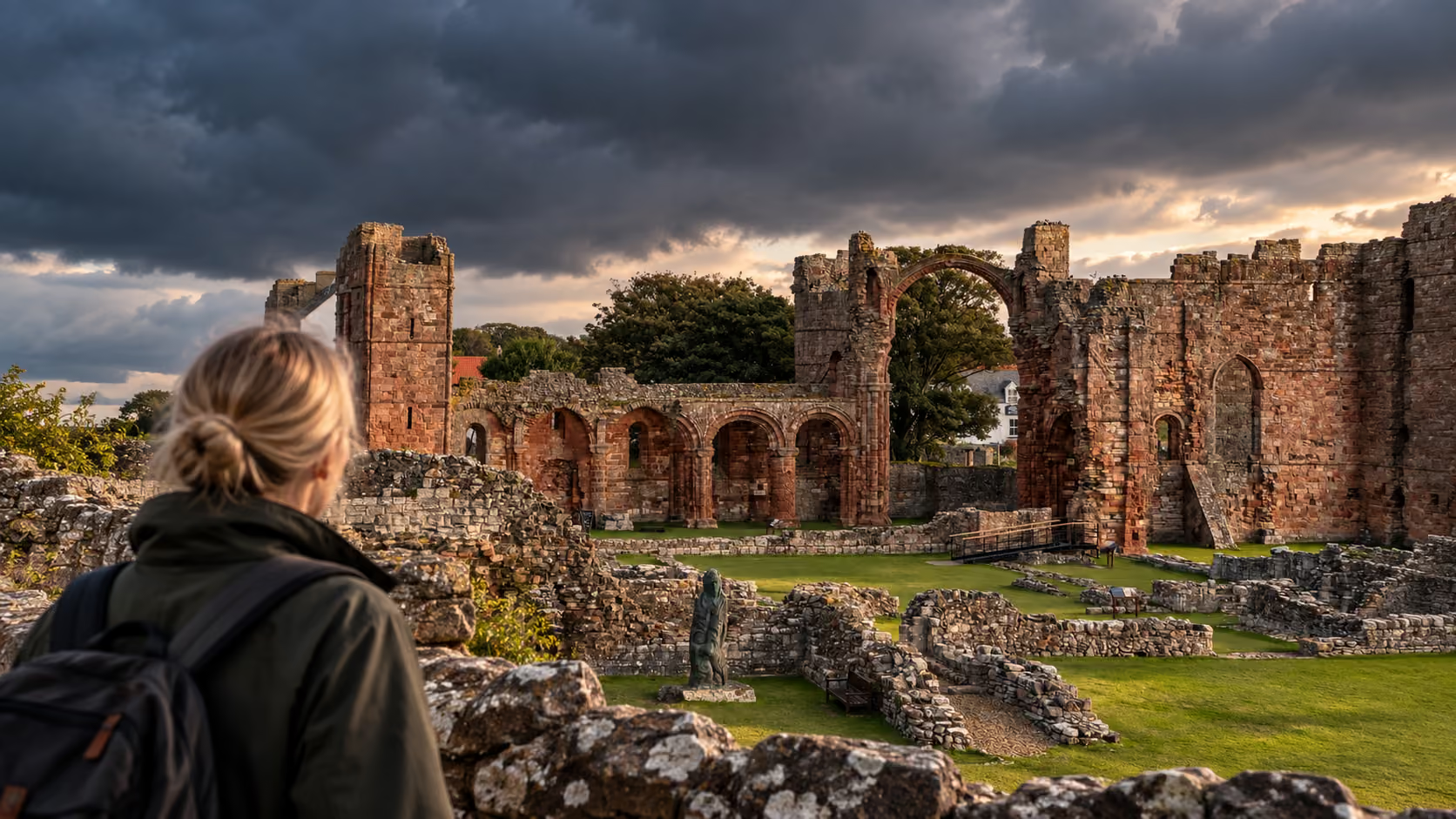
Lindisfarne Priory

Lindisfarne Priory

Atmospheric ruins where St Aidan founded his monastery in the seventh century, with a small museum and views back across the water to the Northumberland coast.

Address:

Holy Island, Berwick-upon-Tweed, Northumberland, TD15 2RX
Call:
01289 389200

Hours:

Times vary daily with the tide

Check English Heritage before crossing

Map

The red-sandstone ruins of the priory sit at the heart of Holy Island village, on the site where St Aidan founded his monastery in the seventh century at the invitation of King Oswald.

  • Good for: History · Photography · Atmosphere · Northumberland coast views
  • Allow: 1–2 hours, including the small museum
  • Don’t miss: The museum and the view back across the water towards Ross Sands and Bamburgh
  • Dogs: Dogs on leads are welcome in the ruins
  • Getting there: About five minutes’ walk from the island car park, through the village towards the parish church
  • H&S tip: Opening times follow the tide as well as the clock. Check both before you cross.

‍

Lindisfarne Priory — A Brief History

Few places in England have a story as old or as influential as Holy Island, once one of the great centres of early Christianity in Europe.

635 — St Aidan Arrives
At the invitation of King Oswald of Northumbria, the Irish monk Aidan comes from Iona and founds a monastery on the island.

685 — St Cuthbert
Cuthbert becomes Bishop of Lindisfarne. He dies on Inner Farne in 687 and is buried here, and his shrine draws pilgrims for generations.

c. 715 — The Lindisfarne Gospels
The monks produce the Lindisfarne Gospels, one of the most beautiful illuminated manuscripts ever made, in honour of Cuthbert.

793 — The Vikings
A Viking raid on the monastery shocks Christian Europe and is often seen as the start of the Viking Age in Britain.

875 — The Monks Leave
Facing further raids, the community leaves the island carrying Cuthbert's body, eventually settling at Durham.

1100s — A New Priory
Monks from Durham build a new Benedictine priory on the site. Its red sandstone ruins, including the famous 'rainbow arch', are what you see today.

1537 — Dissolution
The priory is closed under Henry VIII, and its buildings slowly fall into ruin.

Today — English Heritage
The ruins and museum are cared for by English Heritage, and Holy Island remains a place of pilgrimage.

‍

Our Time at Lindisfarne Priory

Much Better Without the Crowds

We'd visited Holy Island a few weeks earlier and, if we're truthful, hadn't fallen in love with it.

August had brought cars, queues and crowds. This time we'd deliberately arrived as the crossing window was closing, knowing we'd be staying on the island until the tide released us again.

The difference was remarkable.

By the time we reached the Priory, Holy Island was becoming wonderfully quiet.

Why Here?

The ruins are beautiful, but it was the location that caught us.

Lucy had been reading about St Aidan establishing the monastery here in the seventh century and I kept coming back to the same question:

Why here?

Stand among the ruins with the North Sea around you and it's easy to forget how remote this place must once have seemed. Even today, once the tide covers the causeway, there's a very definite sense that you've left the mainland behind.

A dark cloud passed across the sun while we were there and the temperature seemed to drop in seconds.

Perhaps we'd been discussing ancient beliefs a little too enthusiastically.

Either way, Lucy decided we'd seen enough.

Give It Time

That's probably our biggest recommendation.

Don't treat the Priory as something to tick off between the village and the castle.

Walk slowly. Look through the arches. Notice the changing light on the old stone. Then turn around and look out across the water towards the Northumberland coast.

Holy Island makes much more sense when you stop rushing around it.

Heather & Sand verdict: Lindisfarne Priory is undoubtedly one of Holy Island's headline attractions, but visit when it's quieter and it becomes something more than another historic ruin. The combination of ancient stone, sea, sky and the knowledge that the tide can temporarily cut you off from the mainland gives it an atmosphere that's difficult to manufacture. Very much worth slowing down for.

Read the full story from our visit: Where Is Everybody? — A Strange Afternoon on Holy Island

‍