There are plenty of beautiful beaches in Northumberland. Some are bigger, some quieter, some come with castles conveniently positioned on the horizon.
But the one we walk more than any other is Beadnell Bay.
And the strange thing is, despite having walked it more times than I could possibly count, it never seems to be quite the same beach twice.
The tide sees to that.
A beach that rearranges itself
Beadnell Bay curves south from the little harbour at Beadnell towards Link House Farm at the far end of the bay.
At high tide it can look wonderfully simple — sea, sand and dunes.
Come back the following morning and somebody appears to have rearranged the furniture.
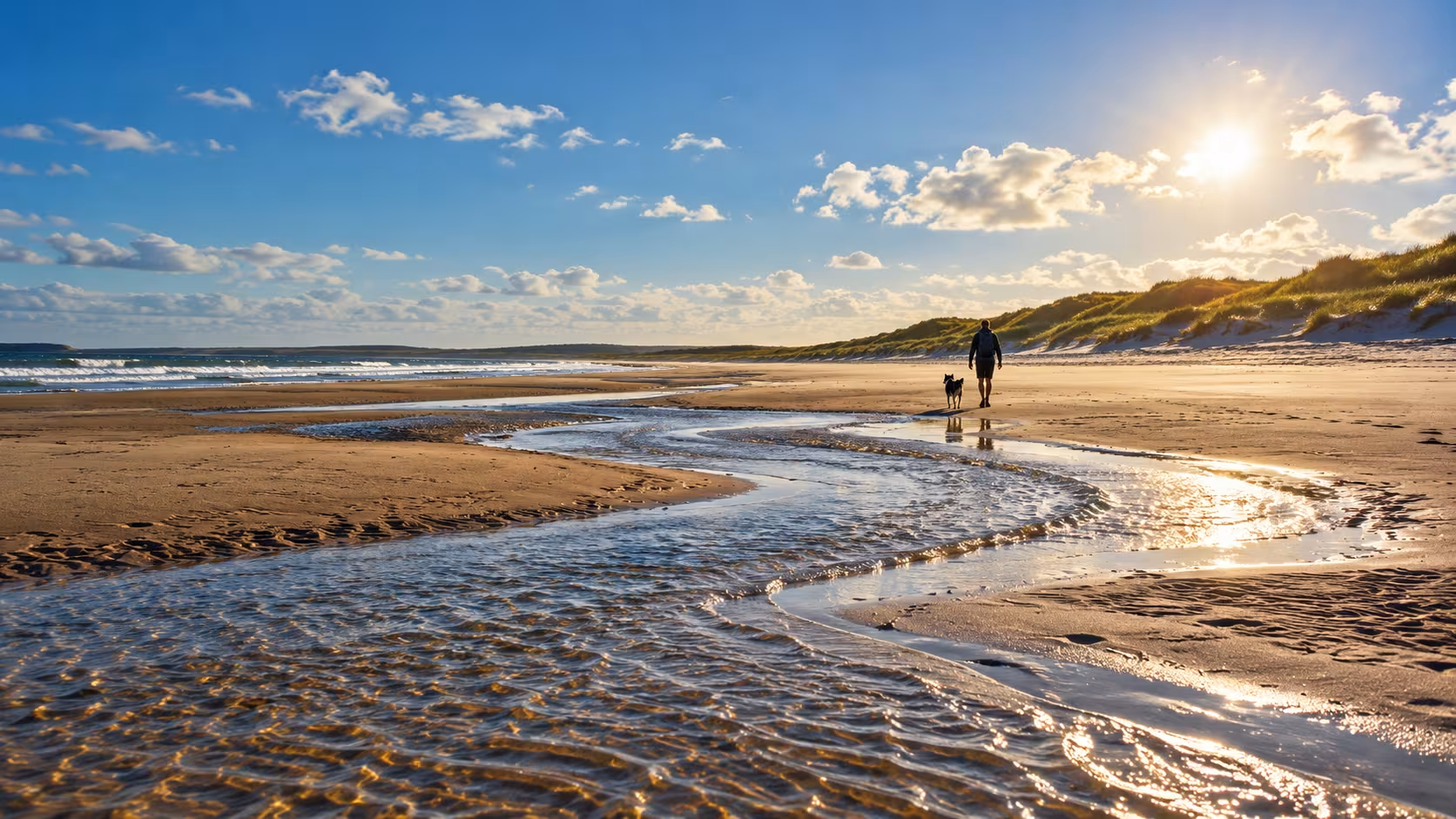
The sea shifts huge amounts of sand around the bay. Pools appear where yesterday there were none. Rocky patches emerge and disappear again. Channels form overnight.
Every now and again, the remains of an old wartime pillbox emerge from the beach.
One week there can be enough exposed to stop and have a proper look. A few tides later, the sand has swallowed most of it again.
There are even stories locally of the remains of a military jeep buried somewhere beneath the sands, occasionally revealing itself during an exceptionally low tide.
We've never seen it.
Which, naturally, means I now look for it every time.
Walk another hundred metres
On a hot summer weekend, the northern end of Beadnell Bay can look busy.
There's parking close by, public toilets and easy access to the beach, and the sheltered water makes this part of the bay popular for watersports.
It's where families tend to settle too. It's close to the car, close to the toilets and doesn't involve carrying half the contents of the car particularly far across the sand.
But Beadnell has a useful trick.
Keep walking.
Within a hundred metres or so, everything begins to thin out.
Walk a little further and the people sitting around the entrance become dots behind you.
Ahead there is simply a huge sweep of golden sand.
Dog walkers.
A few hikers.
Shorebirds picking along the waterline.
And an awful lot of Northumberland sky.
It's one of the reasons we love it.
The mountains of Beadnell
As you head south, the dunes become your companion along the landward side of the beach.
They give the bay wonderful protection when the wind is coming from the west. You can leave the village with coats zipped to your chin, drop down onto the sand and suddenly find yourself in comparative calm.
They're constantly changing too.
Some years sections seem enormous, rising so steeply from the beach that children inevitably discover the obvious purpose for which nature intended them:
Sliding down.
Bodyboards, bits of cardboard, plastic sledges...
Gravity isn't particularly fussy.
Then the wind moves the sand again and the shape changes.
That's Beadnell Bay. Nothing seems entirely permanent.

Crossing Long Nanny
Keep following the dunes south and eventually you'll reach Brunton Burn, although you'll hear almost everyone around here call it Long Nanny.
Calling it a burn makes it sound rather more predictable than it actually is.
Long Nanny has ideas of its own.
Its final journey across the beach changes constantly as the tide pushes sand around. Sometimes it's a narrow little channel. Sometimes it snakes backwards and forwards across a surprisingly large section of beach.
After heavy rain, don't assume you're going to stroll through it without getting your feet wet.
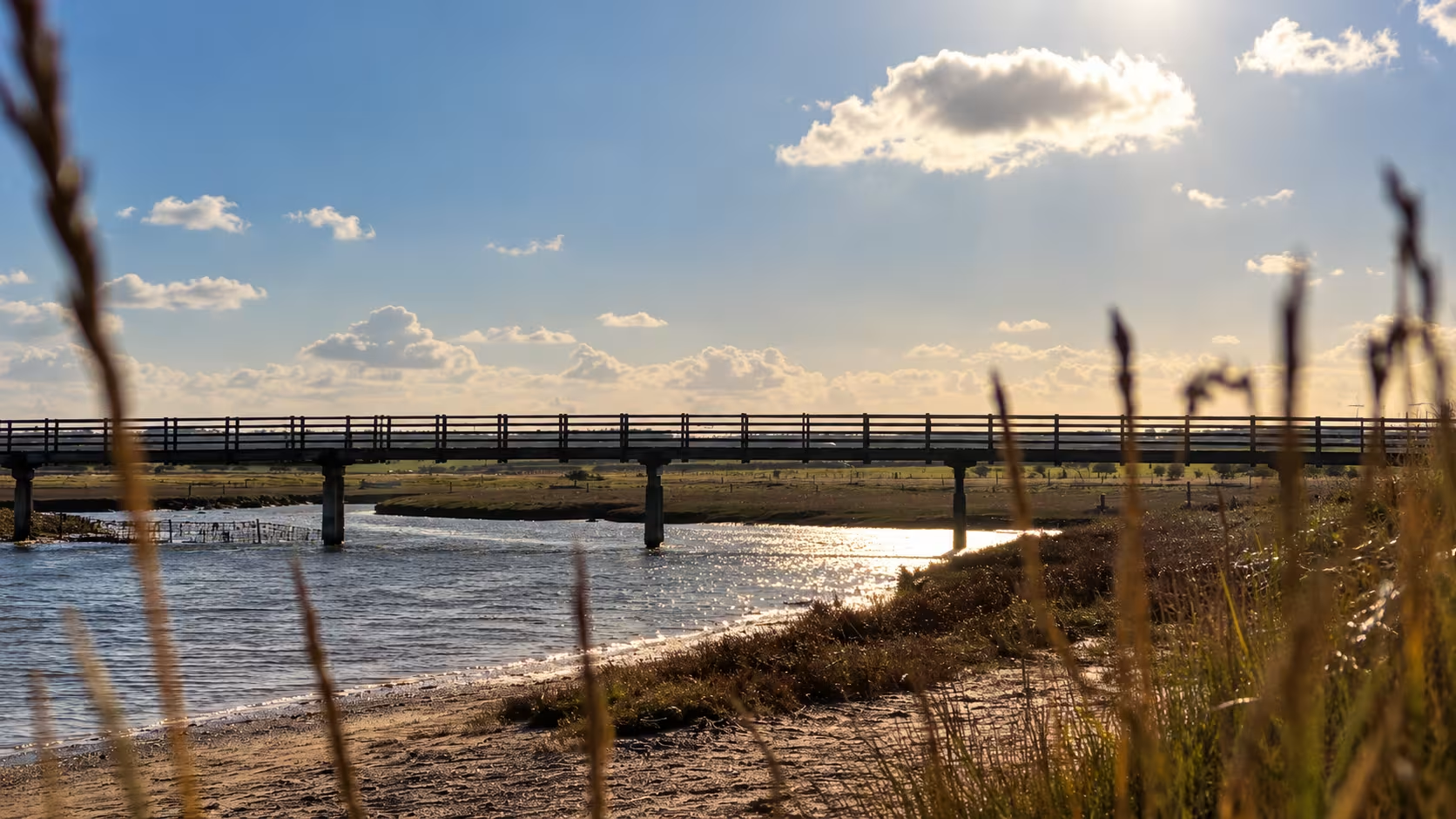
There's a small footbridge set back towards the coastal path for precisely that reason.
At other times the water spreads so thinly across the sand that crossing it becomes a carefully judged sequence of long strides, little jumps and misplaced confidence.
I have occasionally got this calculation wrong.
Most memorably one very cold winter's day when I somehow ended up carrying Lucy across on my back, barefoot, while she carried my boots.
I can't remember exactly how we arrived at this arrangement.
I do remember the water being very cold.
Lucy remembers it as excellent planning on her part.
When the terns return
Long Nanny is also where, during nesting season, an area is protected for the seabirds that return here to breed.
Among them are Arctic terns and the much smaller little terns, and when the temporary fencing and diversions are in place, they're there for good reason.
Meg and I discovered just how seriously the birds take matters one morning at low tide.
We were walking along the water's edge, well out in front of the nesting area, when suddenly the sky above us became rather busy.
Then noisy.
Then very noisy.
There seemed to be a hundred terns circling low overhead, all apparently expressing exactly the same opinion about Meg and me.
Meg kept looking upwards and then back at me.
The expression was fairly clear.
Are you going to do something about this?
No, Meg.
I'm not.
We shifted up a gear.
Turn around — or keep going
For our usual walk, Link House Farm is roughly the turning point.
From Beadnell Harbour down to this end of the bay and back gives us around four miles, depending on how much wandering we've done along the way.
You don't have to retrace your steps exactly either.
Head behind the dunes and pick up the coastal path for the walk north and suddenly the same journey feels quite different.
Or don't turn around at all.
Continue south and you can wander on towards Football Hole, Low Newton, Embleton Bay and eventually Dunstanburgh beyond.
It's one of those stretches of coastline where there's always the temptation to say:
"We'll just go a little bit further."
Several miles later you begin questioning that decision.
The important final few hundred yards
Eventually, though, Beadnell Harbour comes back into view.
And there is one considerable advantage to finishing where we started.
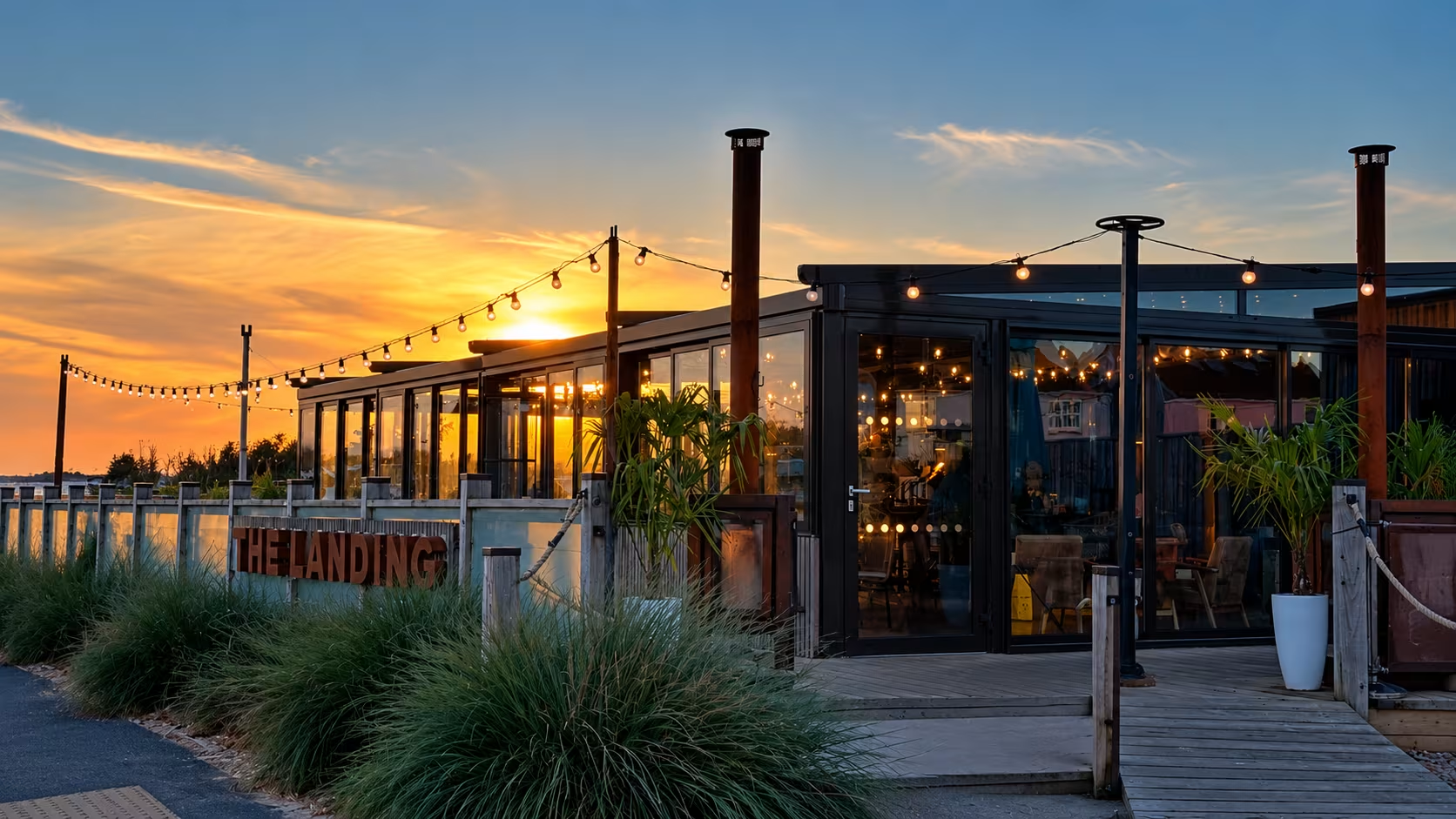
The Landing sits opposite the car park.
On a cold morning that might mean coffee.
On a sunny afternoon it might mean sitting outside with something cold instead.
A pint of Shipyard has remarkable restorative properties after walking four miles along a beach.
This has not, to my knowledge, been medically verified.
Lucy may choose something involving Sauvignon Blanc.
Meg chooses whatever might conceivably fall from the table.
Everyone has their system.
Why we keep coming back
Beadnell Bay isn't hidden.
It isn't a secret beach that requires directions involving an unmarked gate, three sheep and a suspicious-looking footpath.
People come here in their thousands.
But walk beyond that first busy section and the bay becomes enormous again.
And tomorrow it'll be slightly different.
The burn will have moved.
There'll be a pool where there wasn't one before.
A piece of the old pillbox might have appeared.
Perhaps one day that mysterious jeep will finally show itself.
The dunes will have changed shape.
And the tide will have wiped yesterday's footprints clean.
We've walked Beadnell Bay hundreds of times.
I hope we'll walk it hundreds more.
Because sometimes your favourite walk isn't the one that takes you somewhere new.
It's the one that somehow manages to be new every time you come back.
And if you're very lucky, while you're sitting outside The Landing afterwards, you might even spot the odd member of a 1970s pop and rock & roll band.
But that's another story.